How long before bed should I take melatonin?
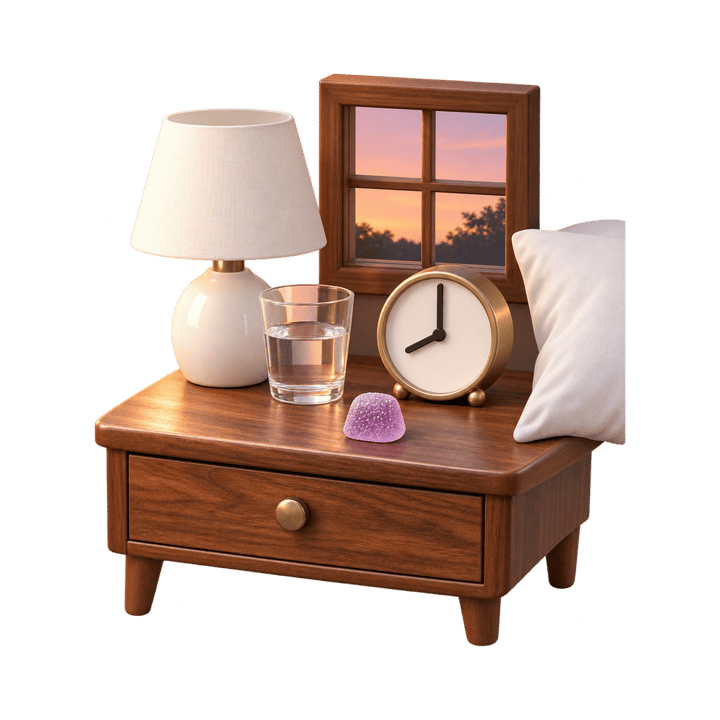
One to three hours before bed. In a 2024 analysis of 26 trials, the longer the gap between the dose and sleep, the more it helped people fall asleep, and the authors suggested about 3 hours. For an 11pm bedtime, take it between 8 and 10pm.
Most labels and a lot of websites still say 30 minutes to an hour. That advice treats melatonin like a sleeping pill, timed to kick in as your head hits the pillow. The 2024 authors compared their finding with the schedule clinics used most, 2 mg half an hour before bed, and suggested moving the dose earlier.
We’d take 0.5 to 1 mg in that 1 to 3 hour window, switch to lamps once it’s in, and judge it on two weeks of your own nights. If you’ve been taking it at lights out and felt nothing, the hour is the first thing to change.
It works like dusk. Your body expects the evening to start a few hours before sleep, and a dusk that shows up at bedtime is late.
Your window, by bedtime
| Asleep by | Take it between |
|---|---|
| 10pm | 7 and 9pm |
| 11pm | 8 and 10pm |
| Midnight | 9 and 11pm |
| 1am | 10pm and midnight |
| 2am | 11pm and 1am |
These are for falling asleep faster. Moving your bedtime earlier for good uses a different, earlier window, about 5 hours before your usual bedtime, and the main timing answer has that table.
Why earlier works
Your own melatonin starts rising about 2 to 2.5 hours before you usually go to bed, and the time you wake on a day off predicts when. A tablet taken in that stretch joins your own evening rise instead of arriving after it.
A tablet also takes a while to get going. In a 2016 Danish study, 12 men swallowed 10 mg and their blood levels peaked about 40 minutes later on average. Take it 30 minutes before bed and the peak lands after the lights are out.
Earlier doses held up in the sleep lab too. In 1995, volunteers took 0.3 or 1 mg at 6, 8 or 9pm. Every dose at every hour shortened the time it took to fall asleep, and nobody had a hangover on the morning tests.
Dim the room when you take it
The tablet is only half of the evening. In a 2011 study of 116 adults aged 18 to 30, ordinary room light in the hours before bed made their own melatonin start later in 99 percent of them, and it ran about 90 minutes shorter. Lamps instead of ceiling lights, from the time you take it, help the dose do its job.
The fine print
If you’re under 18, pregnant or breastfeeding, or take a prescription medicine every day, skip these windows and start with the children’s answer, the pregnancy answer or the medicines answer. Don’t drive after a dose.
Put your bedtime into the calculator below for your own window, or see your dose across the night to check it’s gone by your alarm.
5 sources
- Cruz-Sanabria F and others, Optimizing the time and dose of melatonin as a sleep-promoting drug: a systematic review of randomized controlled trials and dose-response meta-analysis, Journal of Pineal Research, 2024pubmed.ncbi.nlm.nih.gov
- Zhdanova IV and others, Sleep-inducing effects of low doses of melatonin ingested in the evening, Clinical Pharmacology and Therapeutics, 1995pubmed.ncbi.nlm.nih.gov
- Andersen LP and others, Pharmacokinetics of oral and intravenous melatonin in healthy volunteers, BMC Pharmacology and Toxicology, 2016pubmed.ncbi.nlm.nih.gov
- Burgess HJ, Eastman CI, The dim light melatonin onset following fixed and free sleep schedules, Journal of Sleep Research, 2005pubmed.ncbi.nlm.nih.gov
- Gooley JJ and others, Exposure to room light before bedtime suppresses melatonin onset and shortens melatonin duration in humans, Journal of Clinical Endocrinology and Metabolism, 2011pubmed.ncbi.nlm.nih.gov