Does taking melatonin make your body stop making its own?
Short answerNo
On this page
No. In a 1997 study, 21 night shift workers took 0.5 mg or a placebo at bedtime for a week, and their own melatonin came back at the same height afterward. A blind person who took 50 mg a day for 37 days showed no change either. The researchers concluded that melatonin from a tablet can shift the timing of your own, but doesn’t change how much you make.
What we’d do
Don’t worry about wearing out your own melatonin. Worry about the things that do cut it, like bright light late in the evening, drinks close to bed and some medicines. If you stop taking melatonin, keep your wake time fixed, get morning light and keep evenings dim, because the timing it helped set can drift back.
If you remember three things
- Your own output came back the same. A week of 0.5 mg in night workers, and 37 days of 50 mg in one blind person.
- The effect didn’t wear off. In 19 trials melatonin worked as well after weeks of use as at the start.
- Light, alcohol and some medicines do lower it. Room light in the night cut it by more than half in most tests.
Why it seems obvious
With some hormones, taking them from outside tells the body to make less of its own. It’s reasonable to guess melatonin works the same way, and that every gummy is training your brain to give up.
It’s a fair worry for a hormone you might take every night for years. The evidence for melatonin points the other way.
Setting a watch
Taking melatonin is more like setting your watch than refilling a tank. When you set a watch, you change what time it shows. You don’t use up its battery.
A tablet tells your body clock what time it is. Your brain still makes its own melatonin every night, on the schedule the clock now keeps.
What the studies found
Night workers, 1997. A team at Asahikawa Medical College in Japan, with colleagues including A.J. Lewy, gave 21 night shift workers 0.5 mg of melatonin or a placebo at bedtime for seven days. On the eighth day they measured each worker’s own melatonin profile. The height of their own melatonin was unchanged by the treatment.
One blind person, 50 mg for 37 days. The same paper reported a blind person who took 50 mg at bedtime every day for 37 days, which starts at about 170 times a normal night’s peak. Their own melatonin profile didn’t change.
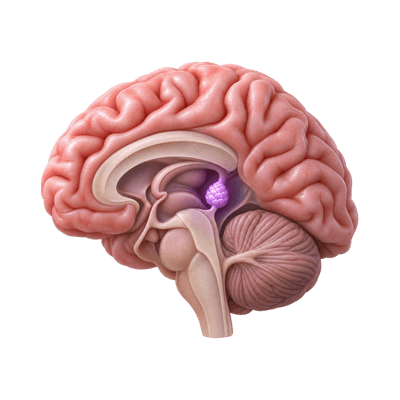
The authors’ conclusion was that melatonin in the blood can shift the phase, meaning the timing, but doesn’t alter the amplitude, meaning the height, of what your pineal gland makes.
The effect doesn’t fade. A 2013 analysis of 19 trials found the effects of melatonin on sleep were modest but didn’t fade with continued use. In a 1995 study of older insomniacs, two months of a nightly slow-release tablet kept working with no sign of tolerance.
These are small studies, and they lasted days to months. Nobody has measured what happens to your own melatonin after years of nightly use, and a 2019 review of 37 trials noted how little long-term evidence there is.
What does lower your own melatonin
| What | How much | Who was studied |
|---|---|---|
| Room light during your usual sleep hours | Cut by more than half in 85 percent of tests | 116 adults aged 18 to 30, 2011 |
| Room light in the evening before bed | Made it start later in 99 percent of people | The same study |
| A moderate drink finished an hour before bed | 15 to 19 percent lower over the next few hours | 29 adults aged 21 to 25, 2007 |
| The active forms of the beta blockers propranolol and atenolol | Overnight output down 80 and 86 percent after one dose | 15 healthy volunteers, 1999 |
| Getting older | Older people typically have lower night melatonin | Noted in a 2001 study of adults over 50 |
If you take a beta blocker, keep taking it as prescribed and raise any sleep trouble with your prescriber.
The best case for the worry
“When I stopped, my sleep got worse. That sounds like dependence.” It can feel that way. In the 1995 study of older insomniacs, sleep quality got worse again after the tablets stopped. That’s the problem the tablet was helping with coming back, rather than a new one caused by the tablet.
There’s a second reason. If melatonin was moving your clock earlier, stopping it lets your clock drift back, especially with bright evenings. No study has tested whether tapering helps, but since your own production isn’t affected, a fixed wake time, morning light and dim evenings are what hold the timing in place.
8 sources
- Matsumoto M and others, The amplitude of endogenous melatonin production is not affected by melatonin treatment in humans, Journal of Pineal Research, 1997pubmed.ncbi.nlm.nih.gov
- Ferracioli-Oda E, Qawasmi A, Bloch MH, Meta-analysis: melatonin for the treatment of primary sleep disorders, PLoS One, 2013pubmed.ncbi.nlm.nih.gov
- Haimov I and others, Melatonin replacement therapy of elderly insomniacs, Sleep, 1995pubmed.ncbi.nlm.nih.gov
- Gooley JJ and others, Exposure to room light before bedtime suppresses melatonin onset and shortens melatonin duration in humans, Journal of Clinical Endocrinology and Metabolism, 2011pubmed.ncbi.nlm.nih.gov
- Rupp TL, Acebo C, Carskadon MA, Evening alcohol suppresses salivary melatonin in young adults, Chronobiology International, 2007pubmed.ncbi.nlm.nih.gov
- Stoschitzky K and others, Influence of beta-blockers on melatonin release, European Journal of Clinical Pharmacology, 1999pubmed.ncbi.nlm.nih.gov
- Zhdanova IV and others, Melatonin treatment for age-related insomnia, Journal of Clinical Endocrinology and Metabolism, 2001pubmed.ncbi.nlm.nih.gov
- Besag FMC and others, Adverse events associated with melatonin for the treatment of primary or secondary sleep disorders: a systematic review, CNS Drugs, 2019pubmed.ncbi.nlm.nih.gov