What does melatonin do?
It tells your body clock it’s night. Your brain releases melatonin as it gets dark, a couple of hours before you usually fall asleep. A tablet is the same molecule. It makes you a little sleepy for a few hours, and it moves your body clock earlier or later, depending on the hour you take it.
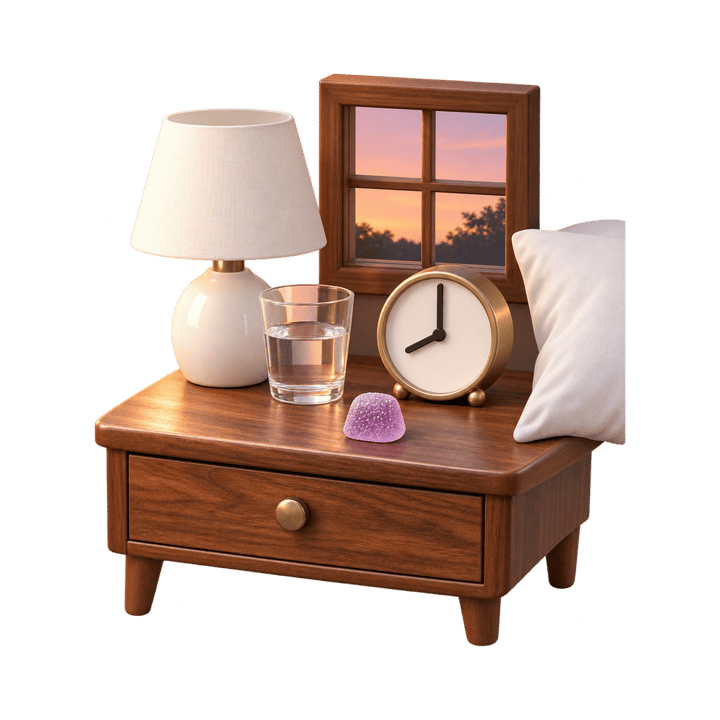
Many people know melatonin as the gummy that helps you sleep, so they treat it like a mild sleeping pill and take it at lights out. It does make you a little sleepy. But its bigger effect is on timing, and a tablet taken at the wrong hour can do very little, or move your clock the wrong way.
We think of melatonin as a message to your body clock, so the hour you take it changes more than the milligrams. A small dose a few hours before bed, with the lights dimmed, is how we’d use it.
It works like dusk. Your body expects night to start a few hours before you sleep, and a dusk that arrives at bedtime is late.
Where it comes from
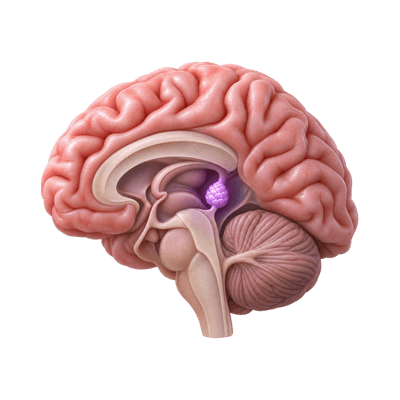
A small gland deep in the brain, the pineal gland, releases melatonin as it gets dark. Light at the eyes holds it back. In 1980, researchers found that ordinary room light didn’t seem to suppress melatonin in six people, even though that much light worked on other mammals, but brighter light did. Later work showed ordinary room light has an effect after all. In a 2011 study of 116 young adults, room light in the hours before bed made their melatonin start later in 99 percent of them and shortened it by about 90 minutes.
The time your own melatonin starts follows your schedule. In people sleeping on their own hours, the time they woke up on a day with no alarm predicted it best, usually within an hour or so.
What a tablet does
The sleepiness is small. On average a tablet gets people to sleep about 7 minutes faster, according to a 2013 analysis of 19 trials. The clock effect is the bigger job. Taken in the late afternoon or early evening, a few hours before your own melatonin starts, it moves your clock earlier. Taken just after you wake up, it moves it later. In a 2010 lab study, 0.5 mg moved the clock about as far as 3 mg when each was taken at its own best hour.
The ring below shows which hours do what on a typical clock.
What’s in the bottle
Supplement melatonin can be made from animals or microorganisms, but most is made in a lab, and it’s chemically identical to your own. In the US it’s sold as a dietary supplement, which the FDA doesn’t approve before it goes on sale. In several other countries it’s a prescription drug.
US adults have taken to it fast. Use went from 0.4 percent of adults around 2000 to 2.1 percent by 2018, a fivefold rise.
What is melatonin? has the full picture, and the melatonin window finds when yours starts.
Why the hour changes the direction
- A tablet here moves you earlier
- A tablet here moves you later
- Light here pushes later
- Light here pulls earlier
9 sources
- National Center for Complementary and Integrative Health, Melatonin: What You Need To Know, last updated May 2024nccih.nih.gov
- American Heart Association newsroom, Long-term use of melatonin supplements to support sleep may have negative health effects, November 3, 2025newsroom.heart.org
- Lewy AJ and others, Light suppresses melatonin secretion in humans, Science, 1980pubmed.ncbi.nlm.nih.gov
- Gooley JJ and others, Exposure to room light before bedtime suppresses melatonin onset and shortens melatonin duration in humans, Journal of Clinical Endocrinology and Metabolism, 2011pubmed.ncbi.nlm.nih.gov
- Burgess HJ, Eastman CI, The dim light melatonin onset following fixed and free sleep schedules, Journal of Sleep Research, 2005pubmed.ncbi.nlm.nih.gov
- Burgess HJ, Revell VL, Molina TA, Eastman CI, Human phase response curves to three days of daily melatonin: 0.5 mg versus 3.0 mg, Journal of Clinical Endocrinology and Metabolism, 2010pubmed.ncbi.nlm.nih.gov
- Ferracioli-Oda E, Qawasmi A, Bloch MH, Meta-analysis: melatonin for the treatment of primary sleep disorders, PLoS One, 2013pubmed.ncbi.nlm.nih.gov
- Freeman DI and others, Emergency department visits for unsupervised pediatric melatonin ingestion, United States, 2019-2022, MMWR, 2024pubmed.ncbi.nlm.nih.gov
- US Food and Drug Administration, Questions and Answers on Dietary Supplementsfda.gov